5 Fabric Textures Every Fashion Illustrator Should Master
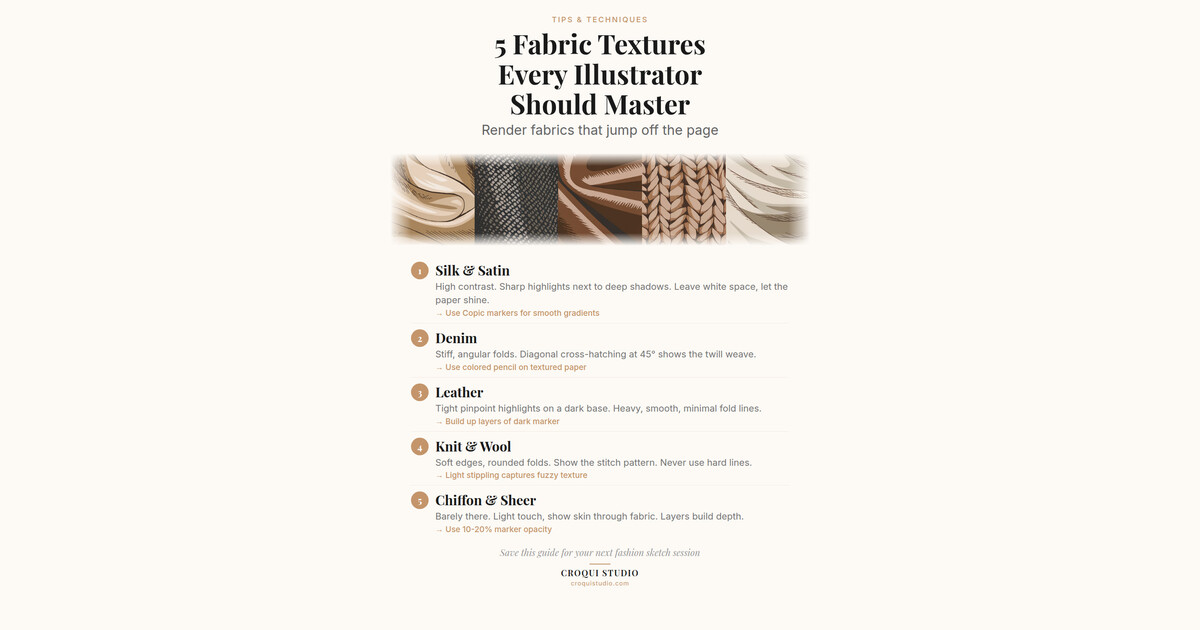
A beautiful silhouette means nothing if the fabric looks wrong. The difference between a flat fashion sketch and one that jumps off the page? Texture. Here are five essential fabrics and exactly how to render each one.
1. Silk & Satin
Silk is all about high contrast. It's the fabric of extremes: brilliant highlights right next to deep shadows, with almost nothing in between.
How to render it:
- Leave white space. The highlights on silk are sharp and bright. Don't shade them at all; let the paper do the work.
- Go dark in the folds. Where silk folds, it goes deep. Use your darkest value right in the crease.
- Minimal midtones. The jump from light to dark should be abrupt. This is what makes silk look "liquid."
- Smooth, flowing fold lines. Silk doesn't wrinkle; it cascades. Your line work should be long, sinuous curves, never jagged.
Best tools: Copic markers for smooth gradients, or graphite pencil with a blending stump for the pencil approach.
2. Denim
Denim is the opposite of silk: it's stiff, structured, and textured. It holds its shape and creates sharp, angular folds.
How to render it:
- Angular fold lines. Where silk curves, denim bends. Folds at the knee, waist, and elbow should be sharp V-shapes or zigzags.
- Cross-hatching for texture. Use fine diagonal lines close together to suggest the woven twill pattern. You don't need to draw every thread, just imply it.
- Highlight the seams. Denim is defined by its construction. Draw topstitching lines along seams, pockets, and hems with a fine-tip pen.
- Vary the blue. Denim fades at stress points: lighter at the knees, thighs, and seat. Darker in the creases and unexposed areas.
Best tools: Sakura Pigma Micron pens for topstitching details, Copic Cool Gray markers for the base.
3. Leather
Leather shares silk's love of contrast, but adds weight and stiffness. It's reflective but rigid.
How to render it:
- Bold, defined highlights. Leather reflects light in concentrated spots. Use a white gel pen or leave paper-white areas for these hot spots.
- Heavy, structural folds. Leather doesn't drape; it bends. Folds should look like they take effort, with volume and thickness.
- Show thickness at edges. Where leather turns (collars, cuffs, hems), draw a visible edge to show material thickness. This is the #1 cue that says "leather" vs. any other dark fabric.
- High saturation. Whether it's black, brown, or red, go bold. Leather absorbs dye deeply.
Best tools: Black Copic marker for the base, white gel pen (Uni-ball Signo) for highlights, Micron pen for edge details.
4. Knit & Wool
Knit fabrics are soft, heavy, and stretchy. They cling to the body and create rounded, organic folds.
How to render it:
- Rounded fold lines. Everything is soft and curved. No sharp angles, no crisp edges.
- Suggest the knit pattern. For chunky knits, draw a few V-shapes or cable patterns in strategic areas (center front, cuffs). Don't cover the whole garment, just enough to communicate "knit."
- Soft edges. Knit garments don't have crisp outlines. Use lighter pressure on your pen/pencil at the garment edges, or use a slightly thicker line that suggests softness.
- Show weight. Knits drape heavier than woven fabrics. Hemlines should sag slightly, and the overall silhouette should suggest gravity pulling the fabric down.
Best tools: Prismacolor Col-Erase pencils for the soft, erasable base drawing, then colored pencils for texture details.
5. Chiffon & Sheer Fabrics
Chiffon is the ultimate test of a fashion illustrator's skill. It's transparent, weightless, and floaty. You need to show fabric that's barely there.
How to render it:
- Show what's underneath. The defining characteristic of sheer fabric is seeing through it. Draw the body (or underlayer) first, then add the chiffon on top with very light, loose strokes.
- Use layering for opacity. Where chiffon layers overlap (gathered areas, ruffles), it becomes more opaque. Build up color gradually in these zones.
- Floating hem lines. Chiffon doesn't hang straight, it floats and drifts. Draw hemlines with gentle waves, as if there's a slight breeze.
- Minimal fold lines. Chiffon is so light it barely folds. Use faint, wispy lines rather than defined creases.
- Light touch with color. Apply markers at 20-30% pressure. Layer up where needed rather than committing to dark values.
Best tools: Tombow Dual Brush pens (the brush tip gives beautiful light washes), or Winsor & Newton watercolors for the most ethereal effect.
The Practice Method
Don't try to master all five at once. Pick one fabric, and for a week, apply it to every design you sketch. Draw a silk evening gown, then a silk blouse, then silk pajamas. By the end of the week, rendering silk will be second nature. Then move to the next fabric.
The fastest way to practice? Use a croquis template so you can skip the figure drawing and focus entirely on the fabric. That's exactly what our sketchbooks are designed for.