Understanding the Fashion Figure: Proportions That Make Your Designs Pop
If you've ever wondered why fashion illustrations look so different from real human bodies, it comes down to one thing: proportions. Fashion designers don't draw realistic figures; they draw idealized ones, deliberately elongated to make garments look their absolute best.
Real Bodies vs. Fashion Figures
A typical adult human body is about 7.5 heads tall, meaning if you stacked the height of someone's head on top of itself, you'd reach their full height in roughly 7.5 lengths. Artists have used this measurement system for centuries.
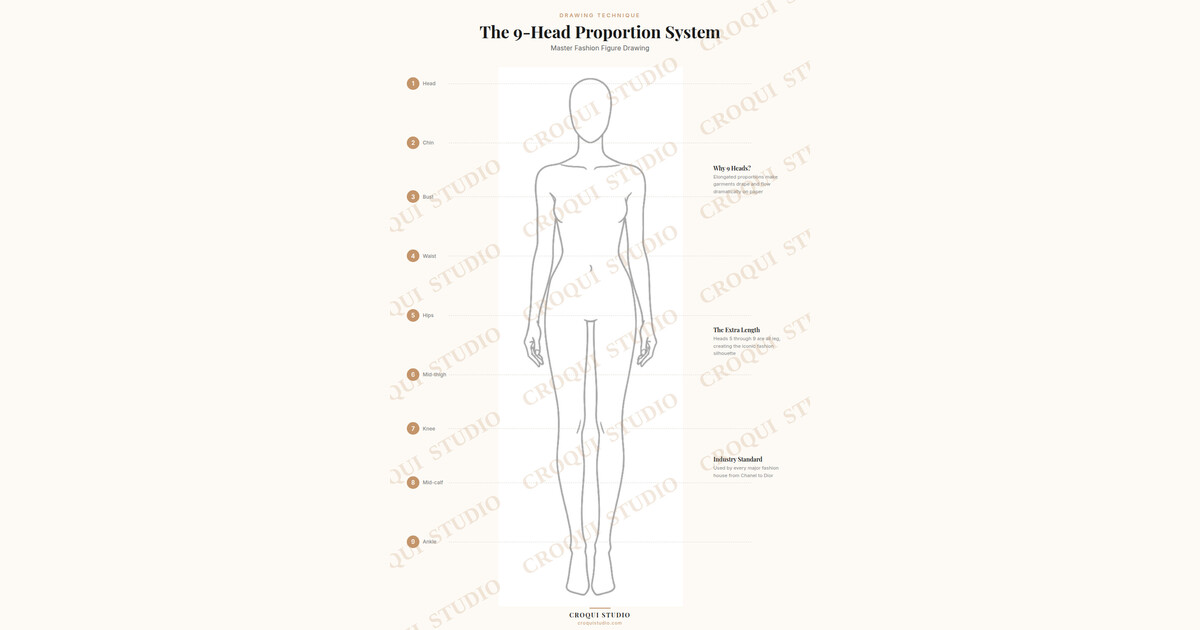
Fashion illustration throws that out the window. The standard fashion croquis uses a 9-head proportion system, sometimes even 10 or 11 heads for haute couture illustration. This extra length goes almost entirely into the legs, creating that distinctive elongated silhouette that makes clothing drape and flow dramatically on paper.
Why 9 Heads?
It's not vanity, it's function. Fashion illustration exists to sell clothing, and elongated proportions do several things:
- Garments read better. More leg length means skirts, pants, and dresses have room to show their full silhouette without cramping the figure.
- Fabric movement is clearer. Longer limbs give the artist more space to illustrate how fabric falls, gathers, and flows.
- The eye is drawn to the clothing. A simplified, elongated body becomes a mannequin; the focus shifts from anatomy to design.
- It's industry standard. Fashion buyers, editors, and designers all expect this proportion. Speaking the same visual language matters.
Breaking Down the 9-Head Figure
Here's how the body divides across 9 equal head-lengths, from top to bottom:
Notice that heads 5–9 are all leg. That's the key difference from realistic proportions, the torso stays roughly the same, but the legs get dramatically longer. The waist sits at head 3 (instead of the realistic ~3.5), and the legs begin at head 4.
Width Proportions
Height isn't the only proportion that matters. Here are the key width relationships in a fashion figure:
- Shoulders: About 1.5 head-widths across (slightly narrower than realistic)
- Waist: About 1 head-width (or even slightly less)
- Hips: About 1.5 head-widths (same as shoulders for a balanced figure)
- Head: Kept deliberately small, this makes the body appear even longer
The Blank Face Convention
You'll notice that professional croquis templates almost never include facial features. The face is left as a smooth oval, sometimes with a faint suggestion of a jawline, but no eyes, nose, or mouth. This is intentional: the figure is a tool, not a portrait. A detailed face would draw attention away from the clothing, which defeats the entire purpose.
Adapting Proportions for Different Body Types
The 9-head system isn't limited to one body type. The same proportional framework applies to:
- Plus-size figures: Same 9-head height, wider proportions at bust, waist, and hip. The elongation still applies, plus-size fashion illustration is not about making figures look smaller; it's about giving garments the same elegant presentation.
- Male figures: Broader shoulders (closer to 2 head-widths), narrower hips, less waist definition. Same 9-head height.
- Children: Shorter proportions (6–7 heads) with a proportionally larger head.
Practice Tips
- Start with a vertical line. Divide it into 9 equal segments. This is your proportion guide.
- Block in the major landmarks first: head, shoulders, waist, hips, knees, ankles.
- Keep the torso compact. The temptation is to stretch everything, but the magic is specifically in the legs.
- Use templates. There's no shame in tracing over a croquis template; that's literally what they're for. It builds muscle memory for proportions.
- Draw lightly. Fashion figures should feel like they're floating, not planted. Light, confident lines beat heavy outlines.
Ready to Practice?
Our Fashion Croquis Template Sketchbook: Paris Edition includes professional 9-head proportion figures with scenic Paris backgrounds, so you can focus on designing instead of drawing mannequins from scratch every time. Each template is printed in light grey so your designs stand out on top.